Exe 7, pg 71

c. Circle the correct words.

1. You can go out tonight, but you mustn’t come home later than 1 am.

2. Great! I’m under 12! I don’t have to pay!

3. Great! No school today – I don’t have to get up early.

4. OK, you can keep it –  but it mustn’t leave this room!

d. Complete the sentences with mustmustn’t, or don’t have to.

1. I mustn’t forget to send my grandmother a birthday card!

2. You really must see that film! It’s great!

3. My parents don’t have to go to work tomorrow because it’s a public holiday.

4. My sister mustn’t go to school yet because she’s only three!

5. Hurry up! We mustn’t be late again.

Homework

Ex 8, pg 64

b. Complete the sentences so that they make sense.

1. Joel doesn’t think very highly of Maths.

2. Joel is grateful because Pete offered to study with him.

3. Pete thinks Joel’s room is too messy.

4. Pete doesn’t really believe that Joel always finds things quickly in his room.

E9, pg 65

a. Find the expressions 1-6 in the story. Who says them? How do you say them in your language?

1. There’s no point in… – Joel

2. There’s nothing wrong with… – Pete

3. It’s up to you. – Pete

4. Anything else? – Pete

5. … all over the place. – Pete

6. if you say so… – Pete

b. Complete the dialogues with expressions 1-6 from Exercise 9a.

1. A: Can I have two kilos of apples, please?

    B: Sure. There you are. Anything else?

2. A: This CD is the best in the history of the world.

    B: Well, there’s nothing wrong with it – but I didn’t think it was very special.

3. A: Where do you want to go tonight?

    B: It’s up to you. I don’t mind where we go.

4. A: Oh no! It’s starting to rain – and we haven’t got an umbrella!

    B: Well, there’s no point in complaining. We just have to walk – and get wet!

5. A: What’s the matter Mum?

    B: It’s the living room, Sarah. You’ve left things all over the place. Please put your things away!

6. A: So what? There’s nothing wrong with that.

    B: Yes there is – you could damage your ears.

6.c

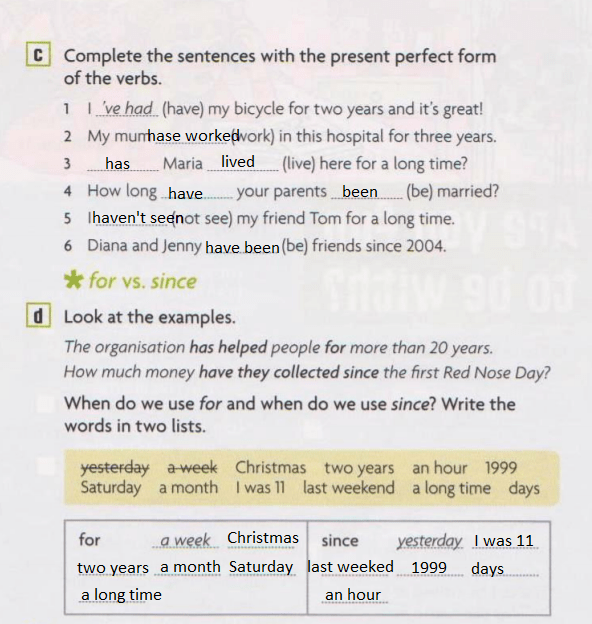
1. I really bicycles! I’ve got two; a green one and a grey one. I got the green bike as a birthday present when I was 12. I bought the grey bike bike with my money.

2. I read a newspaper story about a new plane yesterday. The plane can carry 3,000 people, but the story didn’t say when thry will finish making it.

3. My father drives an old car. He loves it! It was made in 1960, and it looks really beautiful. Every week he gets_ phone calls from _ people who want to buy it. Last week a woman in London. My father didn’t know the woman, but she offered her £10,000 for the car!

4. Last night I had dream. My dream was about _ dogs – lots of them! There was a dog that tried to bite me and I ran away. Some people say that _ dreams tell you _ things about yourself. Perhaps this dream means that I’m afraid of _ dogs!

Disaster

Disaster

A disaster is a serious disruption occurring over a short or long period of time that causes widespread human, material, economic or environmental loss which exceeds the ability of the affected community or society to cope using its own resources. Developing countries suffer the greatest costs when a disaster hits – more than 95% of all deaths caused by hazards occur in developing countries, and losses due to natural hazards are 20 times greater (as a percentage of GDP) in developing countries than in industrialized countries. No matter what society disasters occur in, they tend to induce change in government and social life. They may even alter the course of history by broadly affecting entire populations and exposing mismanagement or corruption regardless of how tightly information is controlled in a society.

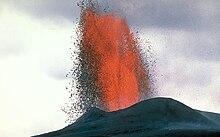
Volcano

A volcano is a rupture in the crust of a planetary-mass object, such as Earth, that allows hot lava, volcanic ash, and gases to escape from a magma chamber below the surface. On Earth, volcanoes are most often found where tectonic plates are diverging or converging, and most are found underwater. For example, a mid-oceanic ridge, such as the Mid-Atlantic Ridge, has volcanoes caused by divergent tectonic plates whereas the Pacific Ring of Fire has volcanoes caused by convergent tectonic plates. Volcanoes can also form where there is stretching and thinning of the crust’s plates, such as in the East African Rift and the Wells Gray-Clearwater volcanic field and Rio Grande Rift in North America. Volcanism away from plate boundaries has been postulated to arise from upwelling diapirs from the core–mantle boundary, 3,000 kilometers (1,900 mi) deep in the Earth. This results in hotspot volcanism, of which the Hawaiian hotspot is an example. Volcanoes are usually not created where two tectonic plates slide past one another.